Noise Therapy
Noise Therapy
Noise Therapy is the black sheep of the Westy project...
It's a solo metal album I am currently working on. In terms of style, it doesn't fit with Westy's scope; however, it reflects my music evolution and works great to show that I don't want to limit my boundaries.
Here is the current state of the project:
- ✅ All songs are fully written, both instrumentally and lyrically.
- ✅ Instrumentals are already recorded.
- ✅ Instrumental mix is done.
- ❌ Vocals won't be recorded until I improve my false cord screaming or find a suitable singer. This may take some time...
Below, you will see the production details of this record.
Virtual instruments:
There are a lot of synth layers in all the tracks of this record. Here is a list of all the virtual instruments I have used:
- Cinematic percussion:
- Keepforest -> Ferrum
- Keepforest -> Devastator
- Orchestral instruments:
- Native Instruments -> Orchestra library
- Sample Logic -> Taste the fury
- Lead synth lines:
- UVI Workstation -> Digital Synthsations
- FabFilter -> Twin 3
- Ambient synth pads:
- FabFilter -> Twin 3
- Logic Pro -> Alchemy
- Native Instruments -> Any library that I felt like messing with.
In terms of mixing, I group these instruments in three busses (HITS & FX - SYNTHS - ORCHESTRA) and apply a gentle compressor for taming the peaks. Some synths need a HPF so that they don't mud the mix, but nothing crazy.
Drums
The drums were MIDI-programmed with GGD's P4 kit.
For mixing, I copy-pasted the settings from a Nolly tutorial on drums mixing for individual channels. For the drum bus, I came up with the following channel strip:
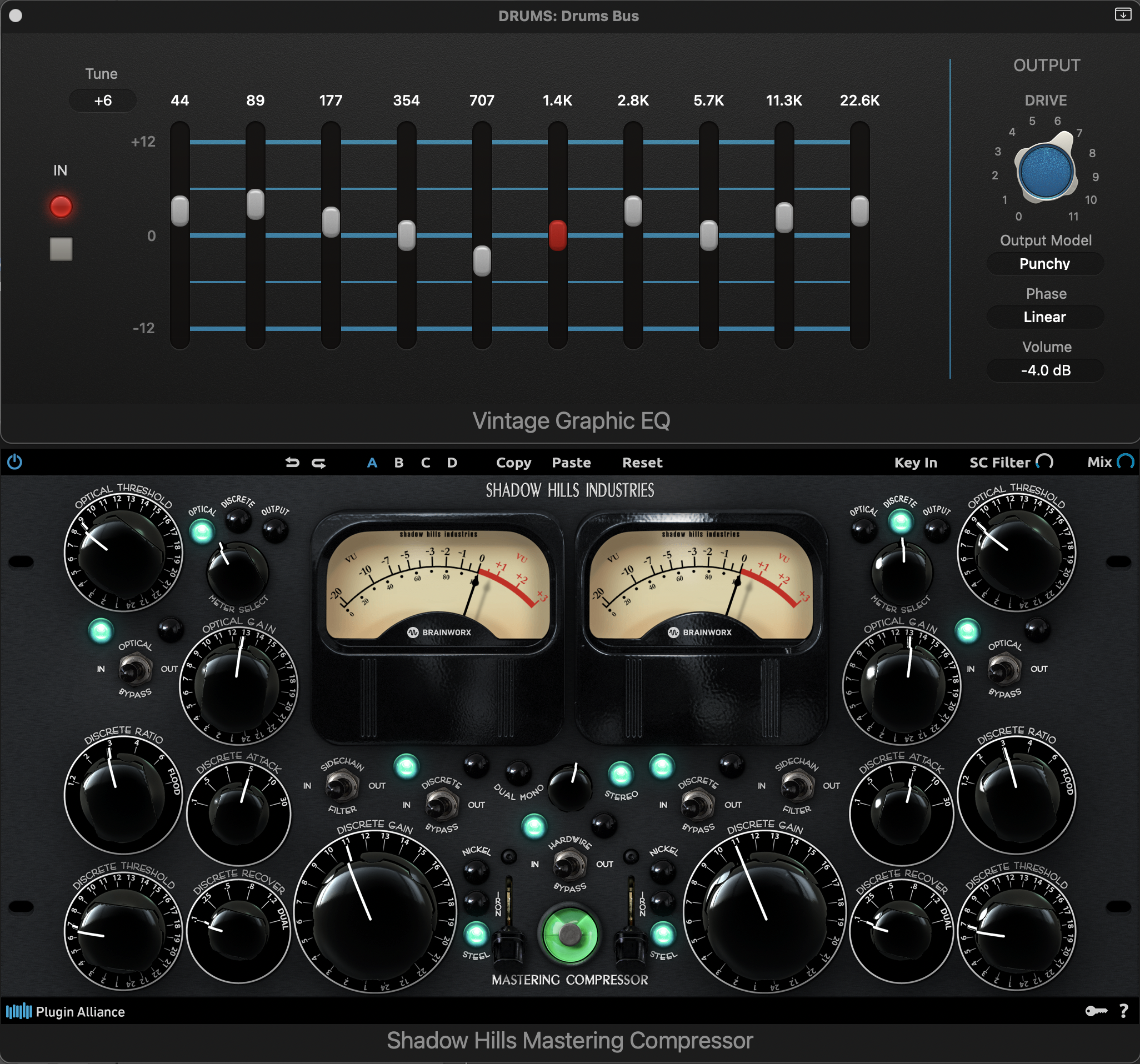
Furthermore, to obtain more punchiness from the drums, I send the whole drum bus to two parallel compressors: one with fast attack / slow release; the other with slow attack and fast release. Their volumes are automated through the tracks so that the drums are always at an apropiate level for each section of the song.
Bass
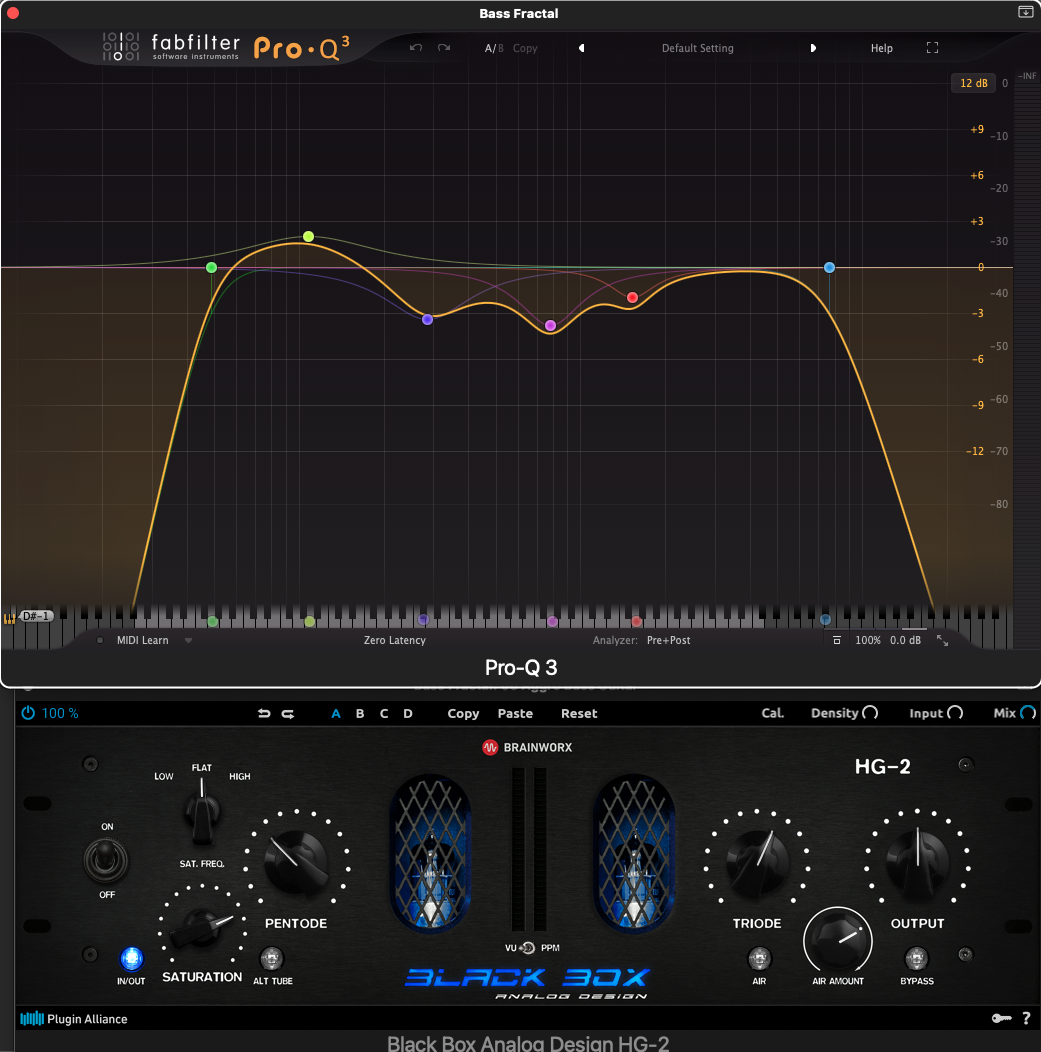
The bass used for the recording was an Ibanez SR2605 through a Fractal FM3 patch. You can hear the raw tones of this patch in this video.
Basically, the hi-end of the bass DI goes through a PVH 6505 amp emulation and the low-end goes through a compressor, then the sum goes into an 8x10 Ampeg cab IR. The amp emulation had different levels of distortion according to the intensity of the parts.
For some parts, I added a phaser plugin in post.
These are the plugins I used for mixing:
Guitars
The guitar used was an LTD H3-1000 through various Fractal FM3 patches.
Rhythmic parts were quad tracked, two performances went through a Revv amp (purple channel with max aggresion) with Recto-style cabs, the other two performances went through a Cameron CCV amp with Cali-style cabs. The Cameron pair has an all-around great tone while the Revv combo is used to add some spark to the high-end. Besides, an Horizon Precision Drive pedal is placed before the amps, it works as the typical booster used in every modern-metal tone.
I try to emulate two different guitarists with each amp; there are parts where the Revv-player is performing alone and vice-versa, and also parts where a different line is performed through each amp.
The last song of the record is way softer. For that song, the Revv amp switches to the green channel (low gain channel) and the Cameron is swapped with a Morgan AC20 emulation.
Lead and dub parts were double tracked with the Cameron rig. For solos, I used the same Revv and Cameron amps, but played around with the overdrive/booster pedal for each take. All these guitars were recorded dry; delay, reverb and other special effects were added later in the mix with plugins, mainly the time-based effects of Archetype:Plini.
For the rhythmic parts, I created a bus for the Revv tracks and another for the Cameron/Morgan tracks; these buses contain an SSL channel strip emulation with different settings and are summed together in an upper-level bus.
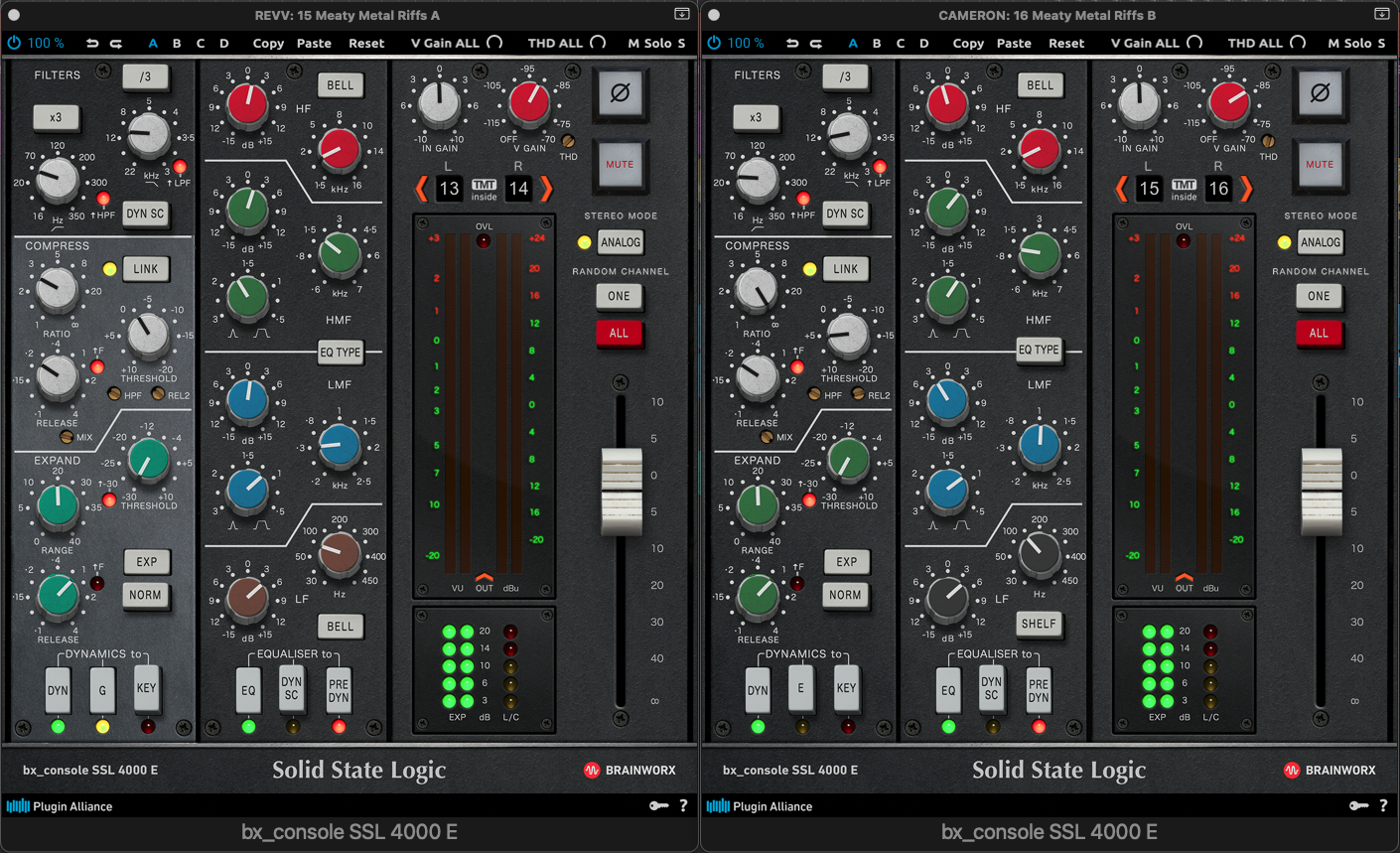
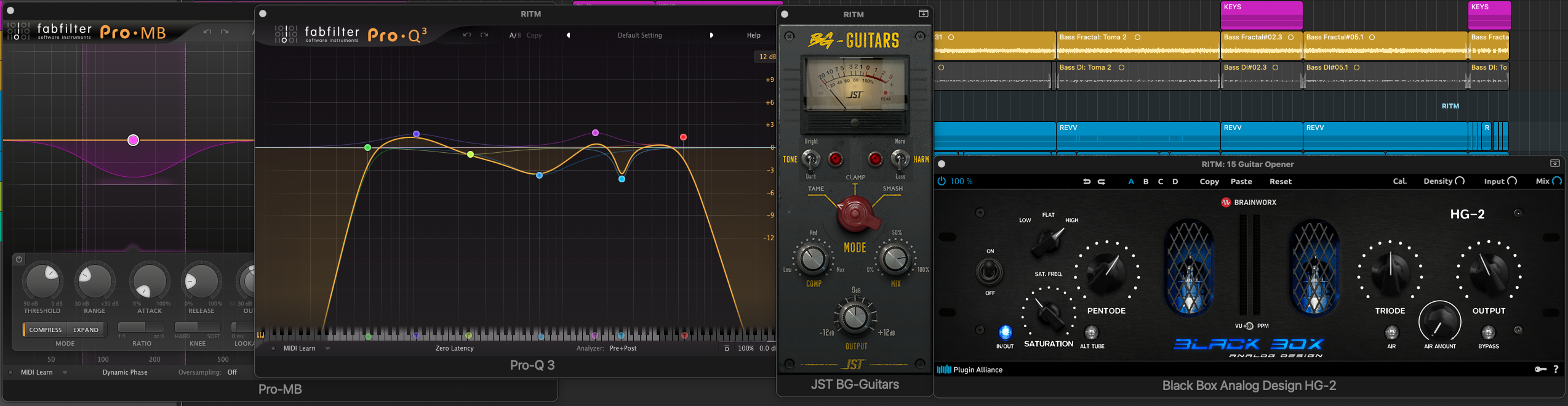
Dubs and lead guitars have a similar processing but with different EQ moves.
Vocals
Vocals are meant to be recorded with an Antelope Edge Solo mic through an Antelope Zen Q interface; this combo allows to emulate different mics. I want to emulate a Sony C-800G mic as I think it is the one that Spencer Sotelo uses for Periphery records.
I also use the interface to emulate some analog gear equipment while tracking vocals. I am using emulations of a Neve preamp, an SSL equalizer, a Fairchild compressor and an LA-2A compressor. In the next photo you can see the settings for each module:
Work in progress...
These are the plugins I used for mixing:
The mix is not ready so there is no photo yet...
Mixing and mastering
Work in progress...
I'd like to show a screenshot with the structure/layout of the mix and the bus groups.
For the mastering, I am applying the two-bus processing approach. Basically, I process the instrumental bus on its own and then sum the vocal bus in the master bus.
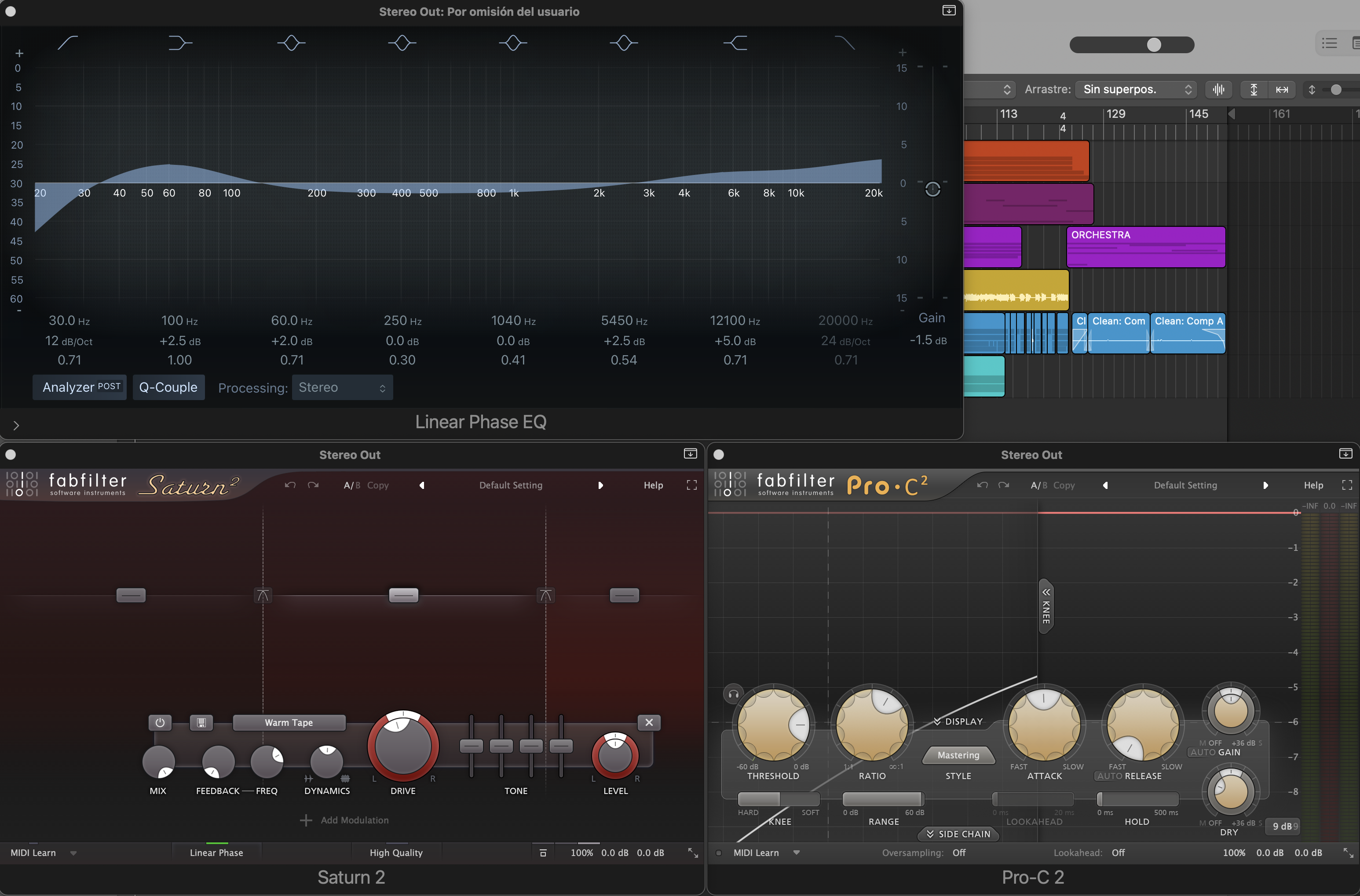
I recently came up with the following plugin chain for the instrumental bus and I am quite happy with the polish it gives to modern-sound productions:
- I apply the EQ curve before mixing. It gives a boost to the lows and adds air from the beginning, so it prevents doing extreme EQ moves to every track.
- The multi-band saturation works like magic. I split bands in 200Hz and 5000Hz and turn up the drive in each band up to where it starts getting fizzy, then I dial it a bit back. Very important: The multi-band saturator must be set to Linear Phase; else, the transients of the drums produce weird artifacts and ruin the whole mix...
- Lastly, I apply a gentle compressor to tame the peaks without clipping them. Using the FabFilter Pro-C2, these are my settings for having the impact of a parallel compressor without sacrificing dynamics:
- Threshold: -6 dB
- Ratio: 4:1
- Mode: Mastering
- Attack: 30ms
- Release: 10ms
- Wet Gain: 0dB
- Dry Gain: -6dB
Lastly, in the master bus, I simply apply a limiter to make sure that the mix won't clip anywhere.
Related links
- Streaming links are not yet available.
- No social media for this project...